A SOLO EXHIBITION OF FIGURATIVE WORKS BY RABIYA NAGI
CURATED by CHRIS. DUGRENIER – TECHNICAL ASSISTANCE: ADRIAN BAYNES
Since the 14th February 2021, the exhibitions curated @The Assembly Room have presented the works of different artists in response to one theme.
This year, we are starting something different. We are giving a Solo Exhibition to one artist to introduce their practice, share the themes they make work about and display the range of materials, techniques and media they use.
Our first artist is Rabiya Nagi.
Based in London, Rabiya Nagi is primarily a painter interested in identity and memory with a sense of the cinematic but she also makes “smaller, cropped compositions that capture the more intimate and fragmented moments of remembering”.
Over the course of the next 3 months, we are presenting a selection of those works; small paintings, prints and sculptures of a cropped figure grouped under the title ‘Corps Exquis’.
Unlike the surrealist game ‘Exquisite Corpse’ (‘Le Cadrave Exquis’), Nagi’s body is full of life, meaning and mischief.
Indeed, an aspect of Nagi’s work is to challenge what we see, inviting us to do a double take.
So, we start ‘Corps Exquis’ from the top, the head.
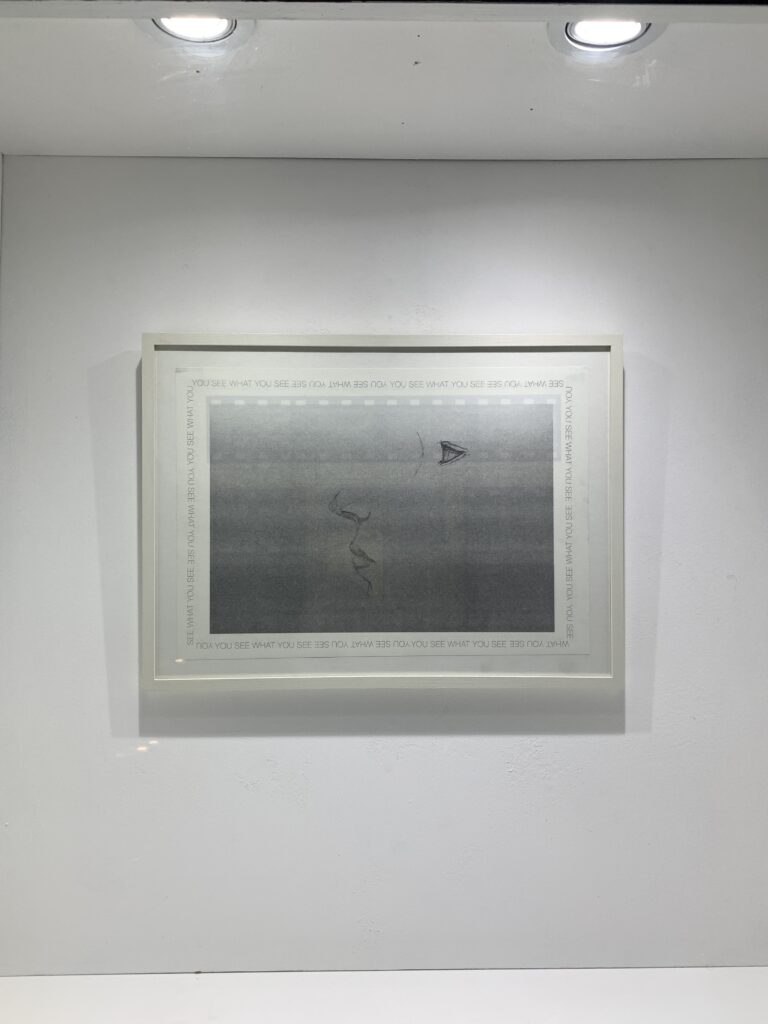
You See What You See is a riso print of a sketch drawing.
It is simple enough no? But are you sure? Is it all as it seems?
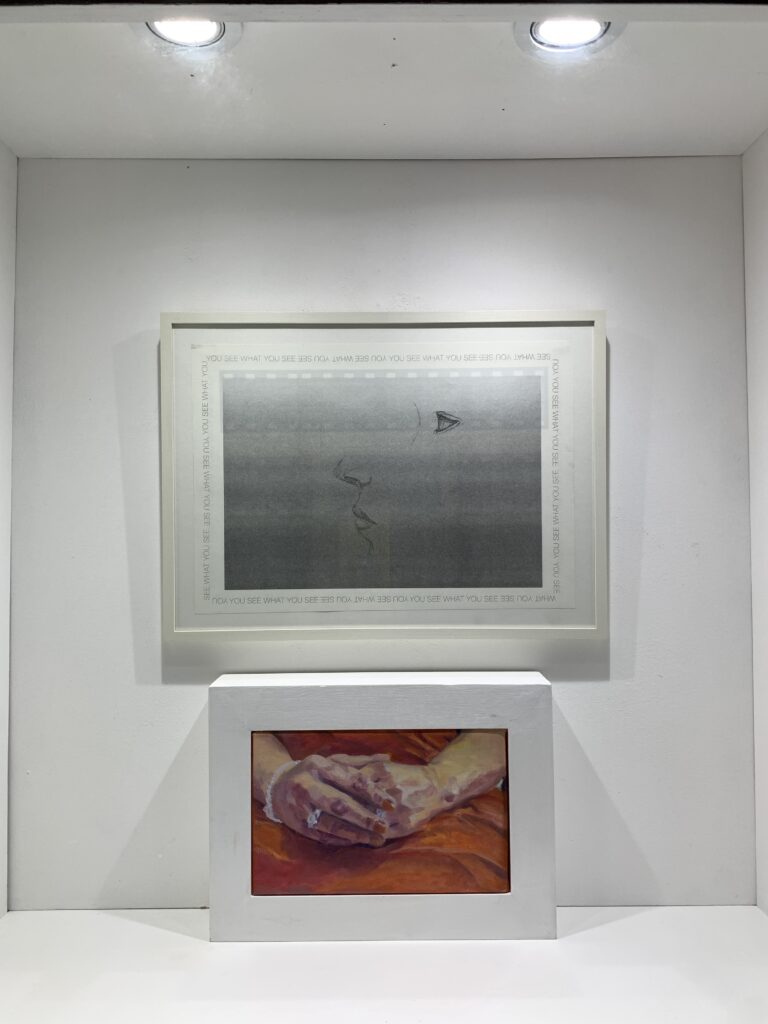
So, we started ‘Corps Exquis’ at the top…
with the head; site of 4 of our 5 senses, it houses our brain which controls virtually everything our body does.
But can we really say this is a head when there is only one eye, half a nose and two lips in profile in view?
In You See What You See, Rabiya Nagi invites us to question how we look and her composition is deliberate.
Using the edges of the paper to frame the few elements that makes this face she creates a sense of totality. Furthermore, the eye is drawn a shade darker than the rest so it immediately attracts our gaze, our attention is diverted and we complete the image in our mind : this is a head.
But, there is something puzzling about it.
Indeed, the gap between the eye and the nose is not to scale… it is wider than it should anatomically be… An accidental ‘decalage’ deliberately not corrected, this shift that does not align is at the centre of the page. `Thus placed, it could be missed but Nagi refers to it in the title – text that she has framed around the work bringing our visual focus to the edges but our mind to that uncanny gab until we finally see it.
The process of looking is at play and we learn that we cannot always trust our own eyes.
We add The Red Dress to the Corps Exquis and now all 5 senses are gathered together.
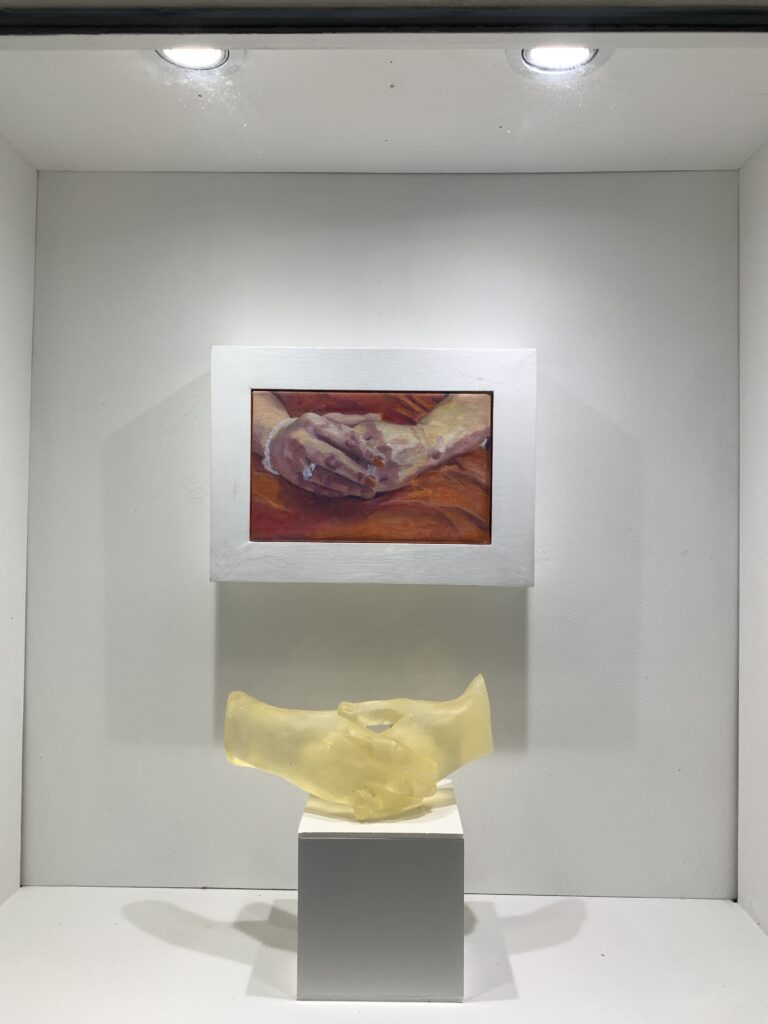
We continue ‘Corps Exquis’ pairing the head with the hands to talk about muscle memory. But first, let’s zoom onto the hands.
The Red Dress is a painting made from a still of Nagi’s video Do You See Me Now (2022) where for 5 minutes, we see a close-up of a pair of hands rested on the red lap of a seated figure. The video shows the tiniest movements that our hands make even when restfully clasped together. Our hands never stop talking.
There is another play about looking and seeing in this video which I invite you to watch here.
In the painting, Nagi moves from the cinematic to the traditional oil format to test different framing strategies and forms of representation.
In The Red Dress, Nagi chose to paint the photograph of her hands fully adorned with gems and pearls framed in crimson to question how we are seen when we are presenting dressed to the nines. This could be a Court Portrait albeit the hands replacing the face.
It could also be a Self-Portrait. Indeed, from fingerprint (unique identifier) to gesture, mannerism and handwriting (graphology), our hands hold so much of our identity.
In this series of works, Nagi indulges in her fascination with hands.
Like feet, hands are notoriously difficult to paint. To master this skill requires the exquisite collaboration of the eye, the brain and the hand. This hand-eye coordination with continuous practice becomes a muscle memory from which artists develop their unique style.
To complete the hand series, here is the 3D version of those previous 2 works called Remember Me, Remember Me?
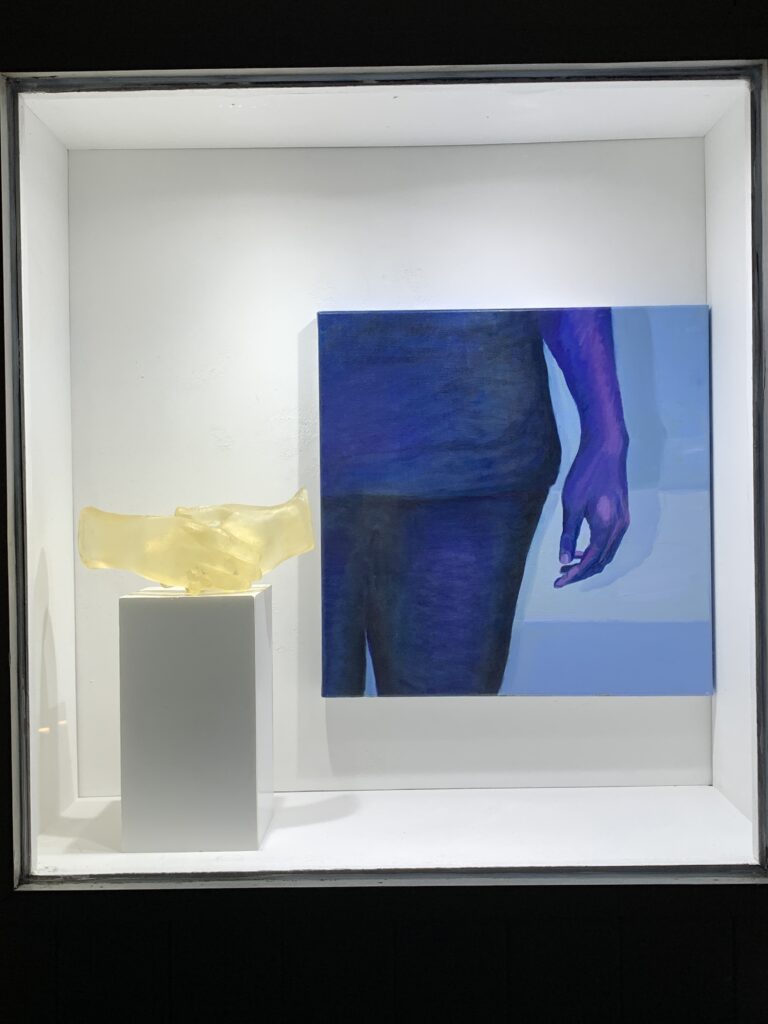
In the fourth display of ‘Le Corps Exquis’, we want to focus on how the body -le corps- is a primordial source for artists and art.
Let’s start with a game: ‘Spot the Difference’ having the previous display in mind.
We had 2 forms of representation: a painting, a flat surface but for the technique of modelling form with light, dark, value and tone of a pair of hands in colour, and a 3D semi-transparent resin casting of the same pair of hands.
We very much like the circular nature in this: the hands that painted themselves where also the hands that were cast in resin.
This is true as well in this current assemblage.
Like many artists, Rabiya Nagi uses herself directly in her art – parts of herself caught in a mirror as in this painting titled ‘Reflection’.
Frozen moments, fragments… a series of incomplete bodies that are yet able to represent and memorialise the full person.
Nagi chose resin as her medium for the sculpture ’Remember Me, Remember Me?’.
Resin creates a form without much colour but where skin textures and fine details are exactly captured. Resin also makes what is solid looks delicate, using light and translucency to convey fragility and ghostly effect.
For Nagi, this artwork expresses how memory fragments, preserves and distorts the body. “It is more than a memory because it is there as an eternal object”.
The hands are key as well because the hand touches. The hand shapes. The hand holds and forms. The hand is the first tool.
And in art, hands are primordial. Indeed, the famous stencils found on caves’ walls over 68000 years ago are the first ever known images of body part made. And what do they show? Hands.
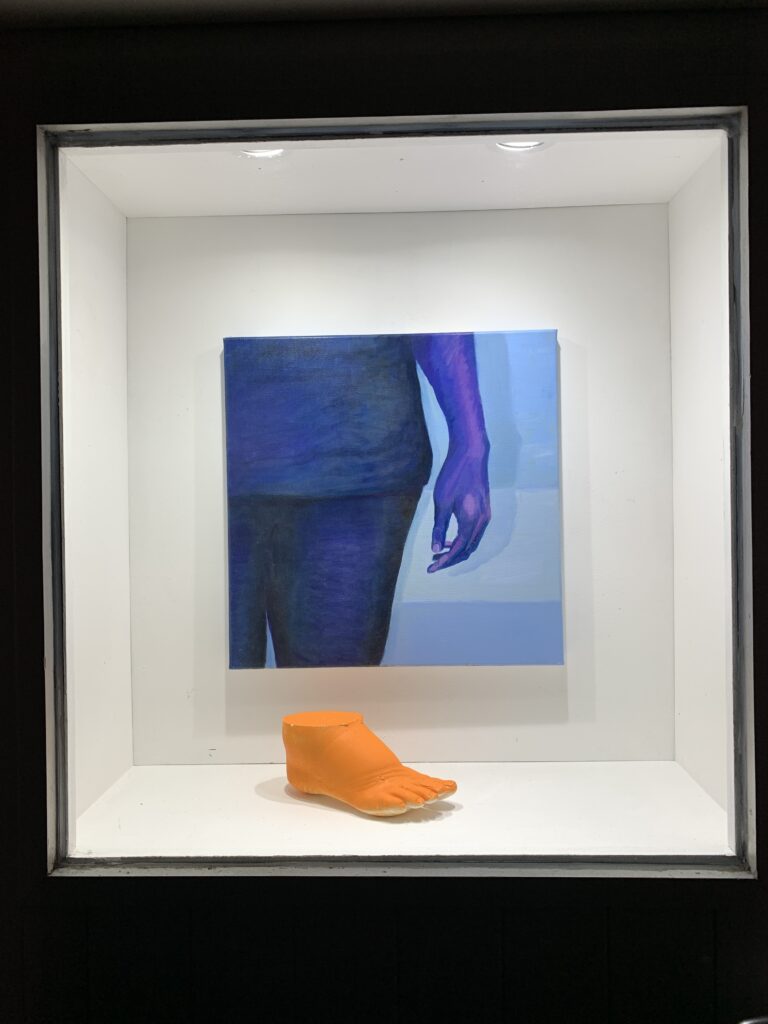
For the 5th display of ‘Le Corps Exquis’, we bring your attention to the largest organ of the human body, our elastic skin.
But before, there is another aspect about fragmentation that Rabiya Nagi employs in this series of works.
By only showing parts, fragments of her body, Nagi reminds us that this is how we tend to feel our bodies. Indeed, we rarely experience our bodies as a complete whole. Sensations are focused on specific areas; where our bodies make contact with the environment, where our body is touched, where our body hurts. We are keenly aware of this when injured, suddenly the sore part being most present in our mind.
Nagi’s sculpture ‘Orange Foot’ was made during a time when prolonged sitting caused her feet to swell. This plaster cast was made to record her changing body, the ankle being twice its normal size. The sculpture is now a marker of that time recalling in its exactitude a moment of vulnerability but also the remarkable flexibility of the skin to contain the inside.
The skin, the boundary between us and the world, is a porous envelope doing so much, protecting, regulating, sensing and slowly marking the passage of time, line by line.
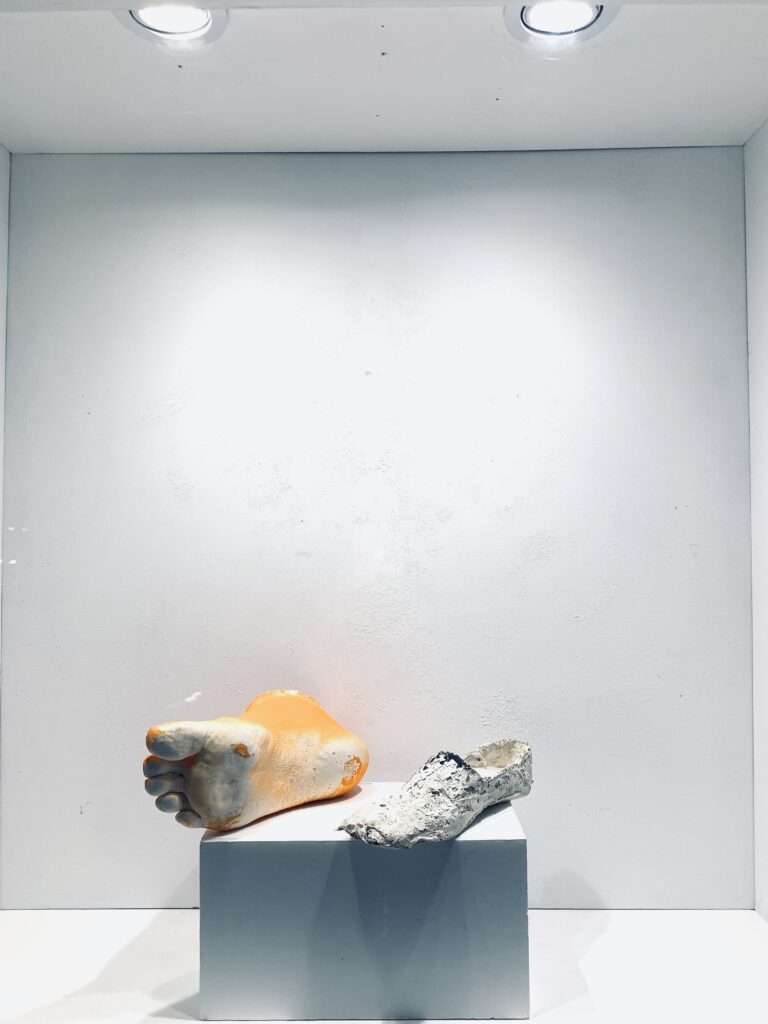
The exhibition ‘Corps Exquis’ started at the top with the head and concludes at the foot of the body.
The plaster cast of Rabiya Nagi’s foot ‘Foot Orange’, capturing a specific visible moment of change reminds us that the exquisite body is fluid and thus always in flux.
Indeed, our physical form like our identity are not fixed states and that story of change, that history is most often written on the skin itself through the lines, the scars, the marks -memento of what the body endures.
Culturally, the skin is also a ‘canvas’ deliberately inked or scared to make visible rites of passage, affiliation, ancestral lineage or individual memories.
Pairing ‘Foot Orange’ with the plaster sculpture ‘Memory 1’, we return to a key theme of Nagi’s practice; that of memory.
‘Memory 1’ looks like a moccasin covered in plaster, some black leather still visible. But, actually – more like a solid echo – this white creamy sculpture, full of air holes casts the void of one of Nagi’s shoes, filling the negative space that the foot normally fills.
Looking closely, we can see the marks of the seams, the texture of the leather as well as fragments of leather stuck to the plaster.
We can see the outside shape of the shoe -and- the shape the toes made inside the shoe. The sole of the sculpture gently echoes the undulation left by the foot, from the toes, the ball, the arch to the heel.
The interior of her shoe is turned exterior and in that process, Nagi preserves the traces of a body, of a life that moulded it.
Curated by Chris. Dugrenier
Technical assistance : Adrian Baynes